
Most North Carolina homeowners discover crawl space moisture the wrong way. A musty smell they cannot locate. Floors that feel soft in one spot. An energy bill that climbs without explanation. By the time any of those signs appear, moisture has usually been present for weeks or months.
This guide explains why NC crawl spaces are uniquely vulnerable, what actually causes moisture to return after a fix, and how to tell whether a repair was done right before problems resurface.
Why North Carolina Crawl Spaces Are a Different Problem
NC sits in a humid subtropical climate zone. Summers run long and humid, and the ground holds moisture well into fall. Most of the state also has clay-heavy soil, which does not drain water quickly. It absorbs it, holds it against your foundation walls, and releases it slowly through evaporation directly into the crawl space below your home.
That combination of high ambient humidity above ground and slow-draining saturated soil below means NC crawl spaces face moisture pressure from two directions simultaneously. Addressing one without the other is why so many repairs do not last.
The Four Entry Points That Matter Most
Ground vapor
This is the largest single contributor in most NC homes. Exposed dirt floors release moisture continuously. Even a basic vapor barrier slows this, but a poorly sealed or thin barrier allows vapor to pass through seams and edges where it accumulates against wood.
Crawl space vents
They were designed to promote airflow and reduce moisture. In NC’s climate, they do the opposite during summer months. Warm, humid outdoor air enters the cooler crawl space, hits its dew point, and condenses on joists, insulation, and ductwork. Sealing vents is now standard practice for NC homes, not an optional upgrade.
Gutters and grading
They determine how much surface water reaches your foundation after rain. Gutters that discharge too close to the foundation, or ground that slopes toward the house rather than away, funnel water directly to the soil surrounding your crawl space. This is a drainage problem, not a crawl space problem, and treating the crawl space without fixing drainage produces temporary results.
Plumbing leaks inside the crawl space
These are frequently missed because nobody goes in there regularly. A slow drip from a supply line or a condensation leak on an HVAC duct can add significant moisture over months before the damage becomes visible at floor level.
Why Fixes Fail: The Part Nobody Talks About
A crawl space repair that addresses one entry point while ignoring others will fail within one to three seasons in North Carolina. This is the most consistent pattern seen across hundreds of crawl space jobs in this region.
Vapor barriers installed without sealing the perimeter at foundation walls allow soil vapor to bypass the barrier entirely through the edges. That vapor still reaches the joists above. The barrier looks complete from below but functions like a tarp with open sides.
Encapsulation installed without dehumidification assumes the sealed space will stay dry on its own. In NC, it will not. Even a well-sealed crawl space accumulates humidity through minor penetrations, HVAC equipment cycling, and air pressure differentials between the crawl space and living area. A properly sized dehumidifier set to maintain below 55 percent relative humidity is not optional in this climate.
Insulation replacement without mold treatment on affected wood leaves active spores on structural surfaces. New insulation installed over treated but untested wood pushes the moisture problem out of sight without resolving it.
What a Complete Fix Looks Like
A lasting repair for a North Carolina crawl space addresses the source, the structure, and the ongoing environment in sequence:
Fix the drainage first. Extend downspouts, regrade the soil around the foundation, and address any standing water entry points before touching the interior.
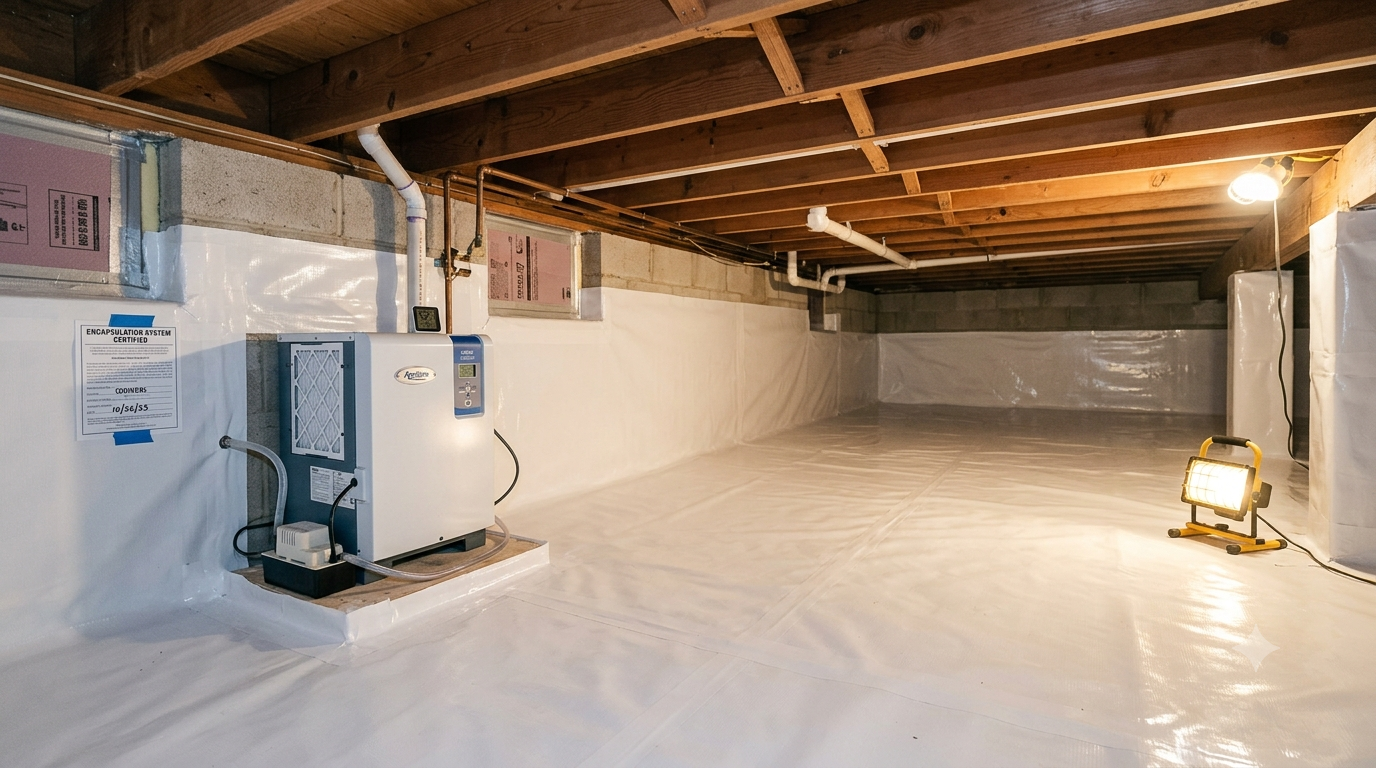
Then address the interior. A 20-mil reinforced vapor barrier sealed at seams and lapped up foundation walls at least six inches, combined with sealed vents and insulated crawl space walls, creates a conditioned space that behaves more like the interior of your home than like the outdoor environment.
Add active humidity control.
A crawl space dehumidifier sized for your square footage keeps relative humidity in a stable range year-round. This is particularly important during NC’s high-humidity months from May through September.
Get a post-repair moisture reading. Wood moisture content should measure below 19 percent on structural members. Above that threshold, conditions still support fungal growth and left unaddressed, this is often where homeowners end up facing a higher mold remediation cost down the line. A contractor who does not take readings at completion is not confirming the job worked.
How to Check Your Crawl Space Without Going In
Most homeowners can identify early warning signs without crawling underneath the house. Pay attention to these:
Floors that feel springy or soft in specific spots indicate joist degradation. Indoor humidity that runs consistently higher than outdoor humidity in summer suggests air is moving up from below. A musty smell concentrated near floor vents or interior crawl space access points is often the first sign of active mold growth below.
A professional inspection should follow any of those observations. Moisture meters and thermal imaging cameras identify the full scope of a problem before it reaches visible or structural damage.
Frequently Asked Question
Q1: Does sealing crawl space vents void my home’s building code compliance in NC?
NC residential building code permits sealed, conditioned crawl spaces as an alternative to vented designs. The sealed approach must include a continuous vapor barrier and mechanical ventilation or dehumidification to meet code. Confirm this with your contractor before work begins.
Q2: How long does crawl space encapsulation last in North Carolina’s climate?
A properly installed 20-mil liner with sealed seams typically lasts 15 to 20 years. Thinner liners sold at lower price points degrade faster under NC’s humidity and temperature cycling. Ask for the mil thickness in writing before signing any contract.
Q3: My crawl space was encapsulated two years ago and moisture is back. What went wrong?
Most reoccurrences trace back to one of three issues: drainage was never fixed at the source, the dehumidifier is undersized or not draining correctly, or the liner seams were not properly sealed at the perimeter walls. Have a moisture meter reading taken on the joists to determine current wood moisture content and work backward from there.
Note: Mold and Moisture Medics has been diagnosing and repairing crawl space moisture in NC and VA since 1984. If your crawl space has not been inspected recently, call us at 919.702.4870 or use our contact form to schedule an assessment.