
Mold removal focuses on physically removing visible mold, while mold remediation is a broader process that addresses the mold, contaminated materials, moisture source, containment, cleanup, drying, and prevention of future growth.
The terms are often used interchangeably, but there is an important difference.
It is not realistic to remove every mold spore from a house. Mold spores naturally exist indoors and outdoors and can enter through doors, windows, ventilation systems, clothing, shoes, and other everyday pathways.
The EPA explains that there is no practical way to eliminate all indoor mold spores. Instead, the goal is to control indoor mold growth by controlling moisture.
A basic mold-removal job may concentrate on cleaning or taking out the material where mold can be seen.
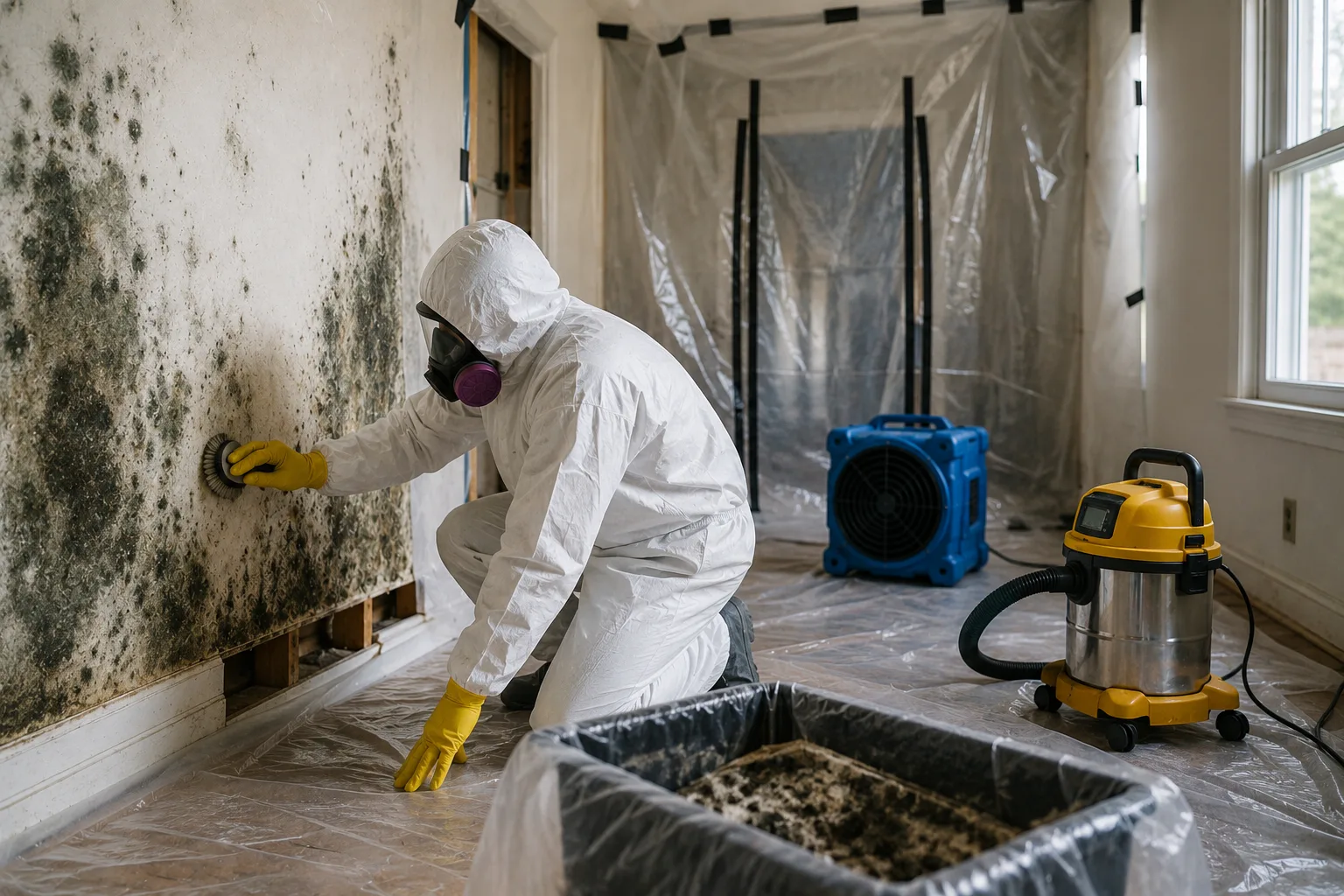
Mold remediation goes further. A proper remediation plan may involve:
Finding the source of water or excess humidity
Determining how far the contamination has spread
Containing the affected area
Removing damaged porous materials
Cleaning surfaces that can be restored
Using HEPA filtration or HEPA vacuuming
Drying the affected structure
Correcting the moisture problem
Checking the area for signs of returning mold
The EPA’s remediation guidance specifically emphasizes fixing the water problem, cleaning and drying affected materials, discarding moldy items that cannot be cleaned, and checking afterward for renewed moisture or mold growth.
That is why mold remediation is usually the better term for a complete solution. The objective is not simply to make a dark patch disappear. It is to correct the conditions that allowed mold to grow.
Why Is Mold Remediation So Expensive?
Mold remediation can be expensive because the work may involve much more than surface cleaning. Professional projects can require containment barriers, protective equipment, HEPA equipment, demolition, disposal, structural drying, moisture detection, specialized labor, and repairs to damaged building materials.
Current 2026 estimates place many professional mold-remediation projects between approximately $1,223 and $3,757, with an average near $2,368. Extensive wall, HVAC, or whole-house contamination can cost considerably more.
The price typically increases when mold is:
Behind drywall
Beneath flooring
In an attic
Inside a crawl space
Connected to an HVAC system
Spread across several rooms
Caused by long-term water damage
Containment is another major factor.
EPA guidance recommends stronger containment as the contaminated area becomes larger or when there is a greater chance of mold and dust spreading to unaffected parts of the building. Full containment may involve multiple layers of sheeting, controlled entry, and negative air pressure.
Some materials can also be difficult or impossible to restore.
Mold can grow into the spaces inside porous materials. Heavily affected drywall, ceiling tiles, insulation, carpet, or similar materials may therefore need to be removed rather than simply wiped clean.
The final bill may also include reconstruction after the remediation crew finishes.
For example, removing moldy drywall is one stage. Installing new drywall, finishing it, repainting the room, and replacing damaged flooring are separate stages that can add to the total project cost.
How Long Should You Stay Out of House After Mold Remediation?
There is no universal number of hours or days that every homeowner must stay out of a house after mold remediation.
The appropriate re-entry time depends on the size of the project, where the mold is located, what materials were removed, whether containment was used, how much drying is required, and whether anyone in the household has greater sensitivity to mold.
In general, occupants should avoid the active remediation area while contaminated materials are being disturbed and removed.
EPA guidance says containment is intended to reduce exposure of both remediation workers and building occupants and prevent contaminated dust and mold from spreading beyond the work area.
Before considering remediation complete, the EPA recommends confirming that:
The water or moisture problem has been corrected
Mold removal has been completed
Visible mold is no longer present
Moldy odors are gone
The area shows no new water damage or mold growth
Occupants can return without health complaints associated with the space
People with weakened immune systems require additional caution. The CDC recommends that people at increased risk from invasive mold infections avoid buildings with mold and remain away until remediation has been completed.
For a professional project, homeowners should ask the remediation contractor when the specific work area and the rest of the home can safely be occupied again instead of relying on a generic waiting period.
Is It Safe to Be in the House During Mold Remediation?
It may be possible to remain in part of a house during some contained mold-remediation projects, but it is not appropriate in every situation.
The decision depends largely on the size and location of the contamination and whether occupants can remain completely separated from the remediation area.
During remediation, workers can disturb moldy drywall, insulation, carpet, wood, or other materials. This activity may release mold particles and contaminated dust into the air.
For this reason, professional remediation frequently uses containment.
The EPA explains that containment is designed to limit the spread of mold throughout a building and reduce exposure for both workers and occupants. Larger contaminated areas or projects likely to generate substantial airborne material may require more extensive containment.
Temporarily leaving the property may make more sense when:
A large portion of the house is being remediated
Multiple rooms are involved
The HVAC system is contaminated
Full containment is required
Extensive demolition is taking place
Access to essential rooms is restricted
Someone in the household has asthma, serious allergies, chronic lung disease, or immune suppression
The CDC specifically advises people with immune suppression or underlying lung conditions not to participate in mold cleanup because they can face greater health risks.
Whether the whole house needs to be vacated should ultimately be based on the remediation plan and the conditions inside the property.
What to Do if You Can’t Afford Mold Remediation?
If professional mold remediation is outside your current budget, the first priority should be to stop the source of moisture so the problem does not continue getting larger.
Repair active plumbing leaks, roof leaks, drainage problems, or other sources of water as soon as possible.
EPA guidance states that homeowners can often clean up a moldy area measuring less than about 10 square feet, roughly a 3-foot-by-3-foot section, themselves. Larger areas, extensive water damage, sewage contamination, or complicated situations may require professional assistance.
If professional help is needed but cost is an issue, consider several options.
Get multiple written estimates.
Ask each remediation company to explain what is urgent, what materials need to be removed, what moisture repairs are required, and what reconstruction is included.
Separate remediation from cosmetic rebuilding.
Depending on the situation, essential mold removal and moisture control may be completed first, while painting or other cosmetic restoration can happen later.
Check your insurance policy.
Coverage often depends on what caused the mold. Mold associated with a covered water-loss event may sometimes be treated differently from mold caused by long-term maintenance problems.
Document everything.
Photograph mold, water damage, leaking pipes, damaged ceilings, flooring, and any other relevant conditions. Keep invoices and records related to the original water problem.
If you rent, notify the landlord in writing.
Provide clear documentation and retain copies of your communication.
Most importantly, avoid simply painting over visible mold.
EPA guidance warns that moldy surfaces should be cleaned and dried before painting because paint applied over mold-contaminated surfaces is likely to peel.
Can Black Mold Be Fully Remediated?
Yes. Mold commonly described as black mold can be successfully remediated when the affected materials are appropriately cleaned or removed and the moisture source is corrected.
The color of mold does not determine the basic cleanup strategy.
CDC guidance explains that molds capable of producing mycotoxins, including Stachybotrys chartarum, should be treated using the same fundamental approach as other indoor molds. Any indoor mold growth indicates a water or moisture problem that needs to be addressed.
Successful remediation does not mean sterilizing the entire house.
Some background mold spores naturally remain in indoor air and household dust. The EPA states that complete elimination of every mold spore is neither practical nor necessary when moisture is properly controlled.
A completed remediation should instead mean that:
Active mold growth has been removed
Materials that cannot be restored have been discarded
Remaining surfaces have been properly cleaned
Wet areas have been dried
The water source has been corrected
Mold is not returning
The CDC also does not recommend routine home mold testing simply to identify what species is present when mold can already be seen or smelled. The important action is to remove the mold and address moisture.
How Long Do Landlords Have to Remediate Mold?
There is no single U.S.-wide federal deadline that gives every landlord a specific number of days to remediate mold.
Landlord responsibilities and repair deadlines depend on state law, local housing codes, the lease, the cause and severity of the moisture problem, and other circumstances.
The EPA does not regulate indoor mold through a federal residential mold standard and does not intervene in individual landlord-and-tenant disputes. The agency directs renters to state and local health or housing authorities when persistent moisture problems are not being addressed.
Because of that, claims such as “every landlord has exactly 7 days” or “all landlords have 30 days” should not be applied nationwide.
A renter who finds mold should generally:
Notify the landlord or property manager promptly.
Put the complaint in writing.
Photograph visible mold and water damage.
Record the date the problem was reported.
Report leaks and moisture problems clearly.
Keep copies of emails, text messages, letters, and repair requests.
Review applicable state and local rental-housing rules.
The EPA specifically advises renters to report plumbing leaks and moisture problems immediately to the building owner, manager, or superintendent. If persistent water problems are not addressed, renters can contact appropriate local or state housing, health, or environmental authorities.
For a location-specific article or service page, this section should be updated using the law of the state and city where the business operates.
What Happens if You Don’t Remediate Mold?
Ignoring mold allows the moisture problem and resulting material damage to potentially become worse.
Mold requires moisture to grow. If the leak, condensation, flooding, or humidity problem remains unresolved, mold may continue spreading into additional materials.
The EPA warns that mold damages the materials it grows on and that the longer it remains, the greater the potential damage.
A problem that initially affects one section of drywall may eventually involve:
Wall cavities
Insulation
Baseboards
Flooring
Ceiling materials
Wooden framing
Adjacent rooms
Water damage can also create damage independently of the mold itself.
There are potential health concerns as well.
The CDC reports that people spending time in damp or moldy environments may experience nasal congestion, sore throat, coughing, wheezing, eye irritation, skin irritation, or other respiratory symptoms. People with asthma or mold allergies can experience stronger reactions.
Not everyone exposed to mold develops symptoms, and symptoms alone cannot establish that mold is the cause.
Still, visible indoor mold is a sign that the moisture conditions in the building need attention.
Waiting can also increase remediation costs.
A small accessible mold problem is generally less complicated to address than mold that has spread behind drywall, beneath flooring, through insulation, or into HVAC components.
The best approach is therefore to address both the visible mold and the underlying moisture problem as early as reasonably possible.
What Is the Success Rate of Mold Remediation?
There is no credible universal percentage for the success rate of mold remediation.
You may see companies advertise very high success percentages, but the EPA does not establish a standard national mold-remediation success rate.
There is also no federal safe limit for the amount of mold spores that may exist inside a home.
Instead of assigning remediation a percentage, the EPA evaluates whether the objectives of cleanup have been achieved.
A remediation can generally be considered successful when:
The moisture or water source has been completely corrected
Visible mold has been removed
Mold-damaged materials have been addressed
Moldy odors are no longer present
The area has been properly dried
Follow-up inspection shows no renewed water damage
Mold growth does not return
The area can be occupied normally
This provides a much more useful measure of success than saying remediation works “95%” or “99%” of the time.
The long-term result is strongly connected to moisture control.
If a professional removes all visible mold but leaves a roof leak or plumbing problem unresolved, mold may return.
If the contaminated material is properly removed, the structure is dried, and the source of moisture is corrected, the conditions that supported the original growth have been addressed.
That is the main difference between temporarily making mold disappear and completing a proper mold remediation project.
Final Takeaway
Mold removal and mold remediation are related, but they are not exactly the same thing.
Removal addresses existing mold. Remediation looks at the larger problem: where the moisture came from, how far the contamination spread, what needs to be removed or restored, how the structure should be dried, and what needs to change to prevent the mold from returning.
For a small area, homeowners can sometimes handle cleanup themselves. Larger, hidden, recurring, HVAC-related, or water-damage-related problems often require a more comprehensive approach.
No remediation company can realistically promise to remove every microscopic mold spore from a building. A better measure of success is whether the active growth has been removed, the water source has been corrected, the property is dry, and the mold does not return.