
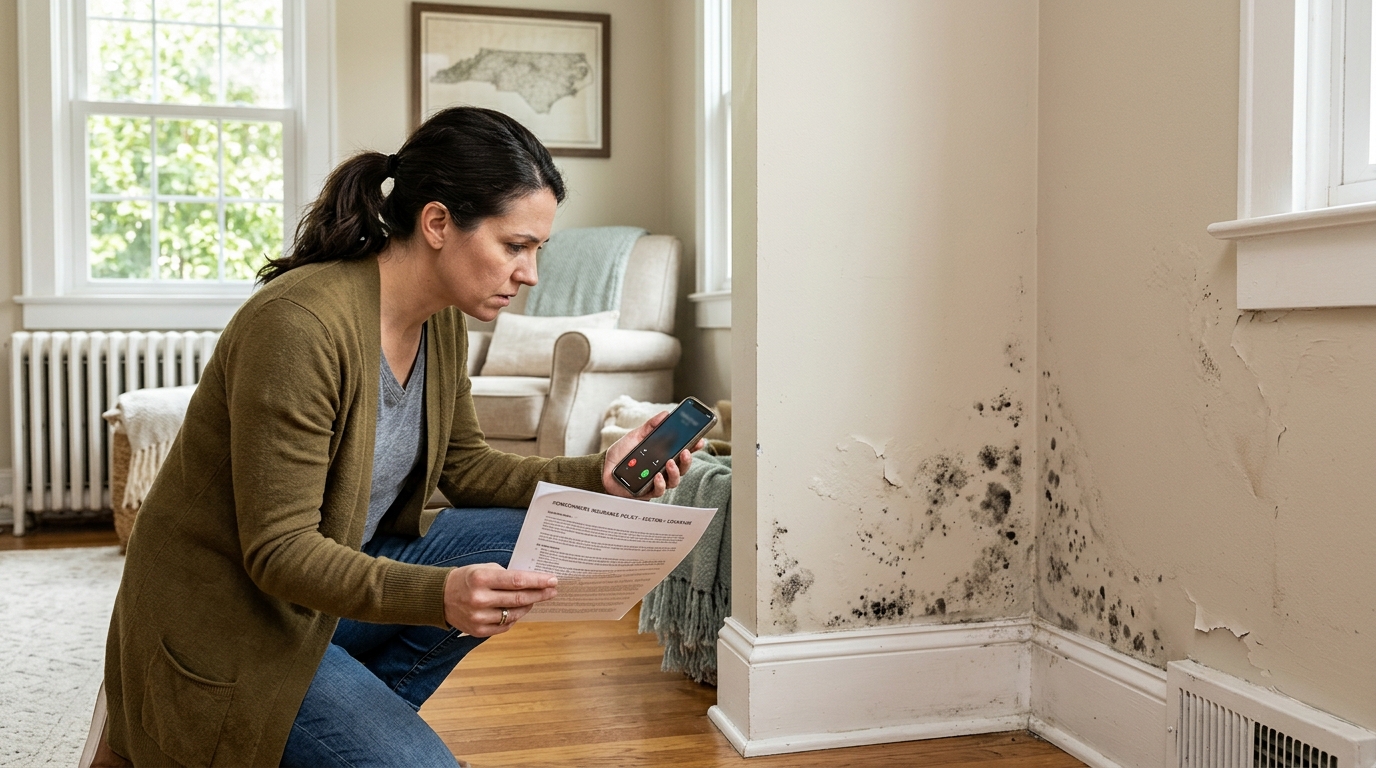
You found mold, and your first thought is probably, “Will my insurance pay for this?” It’s the right question to ask before you spend a dollar. The honest answer is sometimes, but not as often as most homeowners expect.
In North Carolina, standard homeowners insurance usually does not cover mold on its own. Mold may be covered when it results from a sudden, accidental event your policy already covers, such as a burst pipe, and even then the payout is often capped. Mold caused by long-term humidity, a leaky crawl space, flooding, or deferred maintenance is typically excluded.
Your exact coverage depends on your policy, your insurer, and what caused the moisture. Always check your declarations page and talk to your agent.
When Homeowners Insurance May Cover Mold in NC
Insurers generally look at why the mold appeared, not just that it’s there. Mold is more likely to be covered when it follows a covered peril, meaning a sudden and accidental event your policy lists, such as:
- A burst or frozen pipe
- A sudden leak from a water heater, dishwasher, or washing machine
- Storm damage that opens your roof and lets rain in
- Other accidental water discharge that you report and fix promptly
In these cases, the water damage is the covered loss, and the mold that grows because of it may be covered as part of that claim. Many North Carolina homeowners policies include a limited “fungi, wet or dry rot, or bacteria” coverage with a dollar cap, so even a covered claim may not pay for the full job. Limits vary by insurer and policy, so look for the number on your declarations page.
When Mold Is Usually Not Covered
Most denials come down to one theme: the insurer sees the mold as a maintenance problem. Mold is commonly excluded when it comes from:
- Long-term humidity or condensation in your home or crawl space
- A slow, ongoing leak that was never repaired
- Neglected maintenance, such as a roof, gutters, or plumbing left in poor condition
- Flooding, since standard homeowners policies do not cover flood damage
- Poor ventilation or drainage around the home
If you’re not sure which category your mold falls into, a professional inspection can help identify the moisture source. You can read more about the risks in our guide to the hidden dangers of mold in your home and how to stop it.
Flood and Water Backup: Two Gaps to Know About
Flood damage. If mold follows rising water, storm runoff, or overflowing creeks, your homeowners policy generally won’t respond. That type of loss falls under a separate flood policy, either through the National Flood Insurance Program or a private insurer. For Henderson homes near Kerr Lake, Lake Gaston, or low-lying areas, this is worth a conversation with your agent.
Water backup and sump pump failure. Water backing up through a drain or a failed sump pump is often excluded unless you’ve added a water backup endorsement. If your home relies on a pump or drainage system, ask whether this coverage is included.
Mold Endorsements and Riders
Some insurers let you add a mold endorsement (sometimes called a rider) that raises your mold coverage limit. It usually costs extra, and availability varies by company. If you’ve had moisture problems before, or you live in a humid area like central and northeastern North Carolina, it may be worth asking about before you need it.
Why Crawl Space Moisture Matters for Your Claim
Here in the Henderson area, a lot of mold starts below the house. Humid summers, clay-heavy soil, and open crawl space vents push moisture under the home, and that moisture rises into floor joists, insulation, and living areas.
The problem for insurance is that this kind of moisture builds slowly. Insurers often treat it as a gradual condition rather than a sudden event, which is why crawl space mold is so often excluded. Controlling humidity before mold takes hold is both the healthier choice and the one that keeps you from facing a denied claim. Our Humidity in Your Home page explains the ideal moisture levels and what pushes them out of range.
What to Do If You Find Mold and Want to File a Claim
- Stop the water source. Shut off the supply or place a temporary fix so the problem doesn’t grow. Insurers expect you to prevent further damage.
- Photograph and video everything before you clean, move, or remove anything. Capture the mold, the damaged materials, and the suspected cause.
- Read your policy. Find your mold or fungi limit, your deductible, and any exclusions.
- Contact your insurance company promptly. Delays can hurt a claim, especially if the insurer argues the damage got worse because you waited.
- Get a professional mold inspection. A written report that identifies the mold and the moisture source gives you something concrete to share with your adjuster.
- Keep every receipt and record, including inspection reports, repair invoices, and emails with your insurer.
- Compare the estimate to your coverage. If the remediation cost is higher than your policy limit, you’ll want to know that before work begins.
Questions to Ask Your Insurance Agent
- Does my policy include a mold or fungi limit, and what is it?
- Is mold covered if it follows a burst pipe or sudden leak?
- Do I have water backup or sump pump coverage?
- Is flood insurance separate, and do I have it?
- Does a mold endorsement exist for my policy, and what does it cost?
- Does the limit cover testing, removal, and rebuilding, or only part of that?
- How soon after discovering damage do I need to report it?
Does Insurance Cover Mold Testing and Inspection?
It depends on your policy and on whether the underlying loss is covered. Some insurers include inspection costs under a covered claim or under the mold limit. Others don’t pay for testing at all unless the claim is accepted. Ask your agent before you schedule, and keep the invoice either way.
What Happens After Remediation?
Mold remediation removes the contamination and addresses the moisture source, but the repair work doesn’t stop there. Drywall, trim, flooring, and paint often have to be replaced afterward. Our team also offers handyman services in Henderson, NC so you can handle repairs with the same local crew instead of hiring a separate contractor.
If your policy pays for only part of the work, ask for an itemized estimate that separates remediation from rebuilding. That makes it easier to see what your insurer will cover and what you’ll pay out of pocket.
Frequently Asked Questions
Is mold covered by homeowners insurance in North Carolina?
Usually only when it results from a covered, sudden event such as a burst pipe, and often only up to a limited amount. Mold from long-term humidity, neglected maintenance, or flooding is typically excluded.
Does insurance cover mold from a roof leak?
It can, if the leak was caused by a covered event such as storm damage and you reported it promptly. A roof that was already worn out or neglected is more likely to lead to a denial.
Does homeowners insurance cover mold from a burst pipe?
Often yes, because a burst pipe is a sudden accidental discharge. Your mold coverage limit may still apply, so check your policy.
Does flood insurance cover mold?
Flood policies may cover mold that results from a covered flood, but terms and conditions vary. Standard homeowners insurance does not cover flood damage.
Why was my mold claim denied?
Common reasons include long-term moisture, lack of maintenance, flood-related damage, a mold exclusion, or a delay in reporting the problem.
Do I need a mold rider in NC?
It’s not required, but in a humid climate it can be worth asking about. Ask your agent what it covers and what the payout limit would be.
Does renters insurance cover mold?
Typically not, except in limited situations tied to a covered event. Renters should also review their lease and notify the landlord in writing.
How do I know if my mold is covered before I call?
Read your declarations page and your policy’s mold or fungi section, then call your agent. A professional inspection can document the cause either way.
Concerned About Mold in Your Henderson Home?
Whether or not insurance ends up covering the work, the first step is the same: find out what you’re dealing with. Mold & Moisture Medics is a family-owned company serving Henderson, Oxford, Louisburg, Warrenton, Franklinton, Butner, Creedmoor, and the surrounding North-Central NC and South-Central VA communities.
Our team will inspect your home, find the moisture source, and give you clear options that fit your needs and budget. Learn more about us on our homepage, or schedule your mold inspection today. You can also call us at 919.702.4870.