
Most mold problems in Henderson, NC homes are never found by sight. They’re found by a smell that won’t go away, a symptom that clears up the moment you leave the house, or a floor that gives slightly underfoot. By the time mold is visible on a wall, it has usually been active inside that wall for weeks which is why knowing the early signs of mold in your home matters more than spotting the mold itself.
Below are seven specific warning signs common in Henderson homes, what each one tells you about where the mold is likely hiding, and how far along the problem probably is.
Sign 1: A Musty Odor That Won’t Localize
A musty smell that follows you through the first floor, gets stronger near floor registers, or never fully clears isn’t normal. In Henderson homes with crawl spaces, that odor almost always originates below the living area. Warm air rising from the crawl space carries mold spores into the rooms above. If the smell is stronger near the floor than near the ceiling, the source is under the house, not in it. A crawl space mold inspection starting at the access point will usually confirm this on the first visit.
Sign 2: Symptoms That Improve the Moment You Leave Home
Persistent nasal congestion, throat irritation, or a cough that eases after a day away and returns within hours of coming back is a consistent field indicator of indoor mold exposure. Henderson homeowners often blame seasonal pollen, which does run high in Vance County. The difference: pollen symptoms follow outdoor seasons. Mold symptoms don’t.
Sign 3: Wall Discoloration That Returns After Cleaning
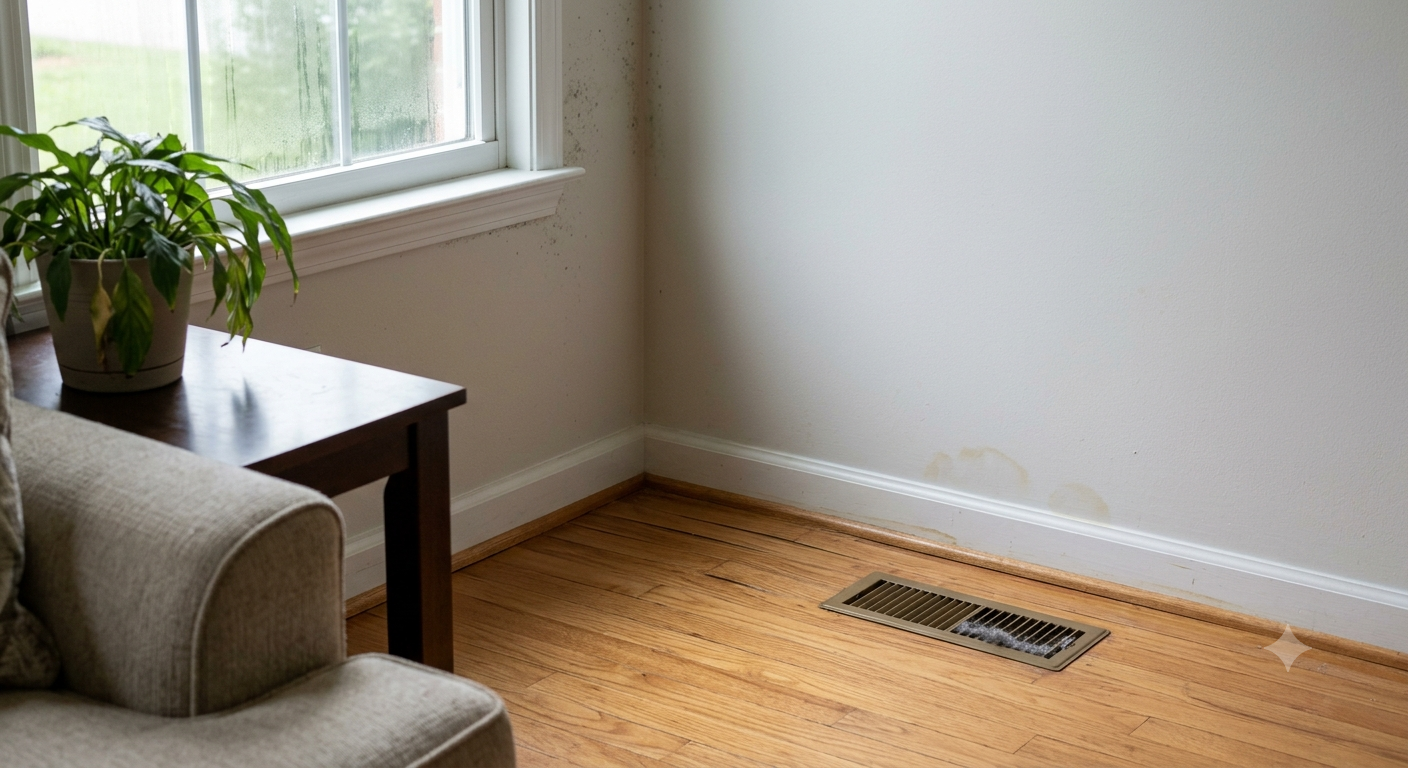
Paint that discolours and comes back after cleaning isn’t a stain it’s mold growing behind the drywall, pushing through because the substrate underneath is saturated. Painting over it hides the surface temporarily, but the colony keeps growing inside the wall. By the time discolouration reappears a second or third time, the drywall behind it is compromised across a larger area than what’s visible. In Henderson’s older housing stock, this shows up most often around exterior wall corners and under windows, where moisture has found a slow, steady path into the wall assembly over years.
Sign 4: Soft or Springy Spots in Your Floor
A floor that flexes underfoot in one localized area has already lost structural integrity below. In most NC homes, that damage comes from sustained moisture. Mold degrades wood fiber from within over months before the surface ever feels soft. By the time you feel it, the structural member below has already lost load-bearing capacity — this is not a cosmetic sign. It means the moisture source has been active long enough to degrade wood, not just support surface growth.
Sign 5: Summer Condensation on Windows or Interior Walls
Winter condensation on windows is common and rarely a red flag. Summer condensation is a different signal entirely. If your windows or exterior wall corners show moisture during warm months, your indoor humidity is exceeding the dew point of those surfaces. In Henderson homes, this is often caused by crawl space air rising into the living zone; as it meets surfaces cooled by air conditioning, it condenses. Persistent summer condensation means those zones are already at mold-growth humidity levels, and mold will establish on any organic surface sustaining that condition for more than 48 to 72 hours.
Sign 6: HVAC Filters Clogging Faster Than Normal
An air filter that reaches capacity in two to three weeks instead of the normal 30 to 60 days is capturing an elevated particle load and in a home with active mold, that load includes spores. Dark residue around supply vents means the air moving through the system carries enough particulate to deposit on nearby surfaces. Together, these two signs point to mold growing inside the ductwork or air handler itself, meaning the system distributes spores throughout the home every time it runs.
Sign 7: Water Stains That Reactivate During Rain
A ceiling or wall stain that reappears or darkens after heavy rain points to an ongoing water entry point. Materials that cycle through repeated wetting without fully drying accumulate residual moisture over time, and above 19% wood moisture content, structural members support active mold growth even without visible wetness. In Henderson, this pattern shows up most often around chimney penetrations, dormers, and aged roofline flashing and it’s frequently present for one to two years before interior damage becomes visible from inside the living space.
What These Signs Mean Together
One sign on its own warrants a close look at your crawl space and a moisture meter check. Two or more signs together particularly any combination of odor, floor softness, or HVAC issues warrant a professional mold inspection. Mold doesn’t stabilize on its own, and moisture problems in Henderson and Vance County don’t resolve themselves without identifying and closing the entry point. Treating surface growth without fixing the source is the most common reason homeowners end up needing a second remediation within two years.
Frequently Asked Questions
If I can smell mold but can’t find it, where should I look first?
Start at the crawl space access and the area around your air handler. In Henderson homes, those two locations account for most cases where a pervasive odor exists without visible surface growth in the living area.
Does a soft spot on my floor always mean mold?
Sustained moisture is the most common cause in NC homes. Have the joist below checked with a moisture meter wood moisture content above 19% confirms conditions that have been, or currently are, supporting mold growth nearby.
Can mold grow in a home that was never flooded?
Yes. Most residential mold problems in Henderson come from crawl space humidity, slow plumbing leaks, and inadequate attic ventilation. Steady ambient moisture over several weeks can produce the same conditions as a single water event.
Mold and Moisture Medics has been inspecting NC and VA homes since 1984. If you’re seeing any of these signs in your Henderson home, call us at 919.702.4870 or use our contact form to schedule an inspection