
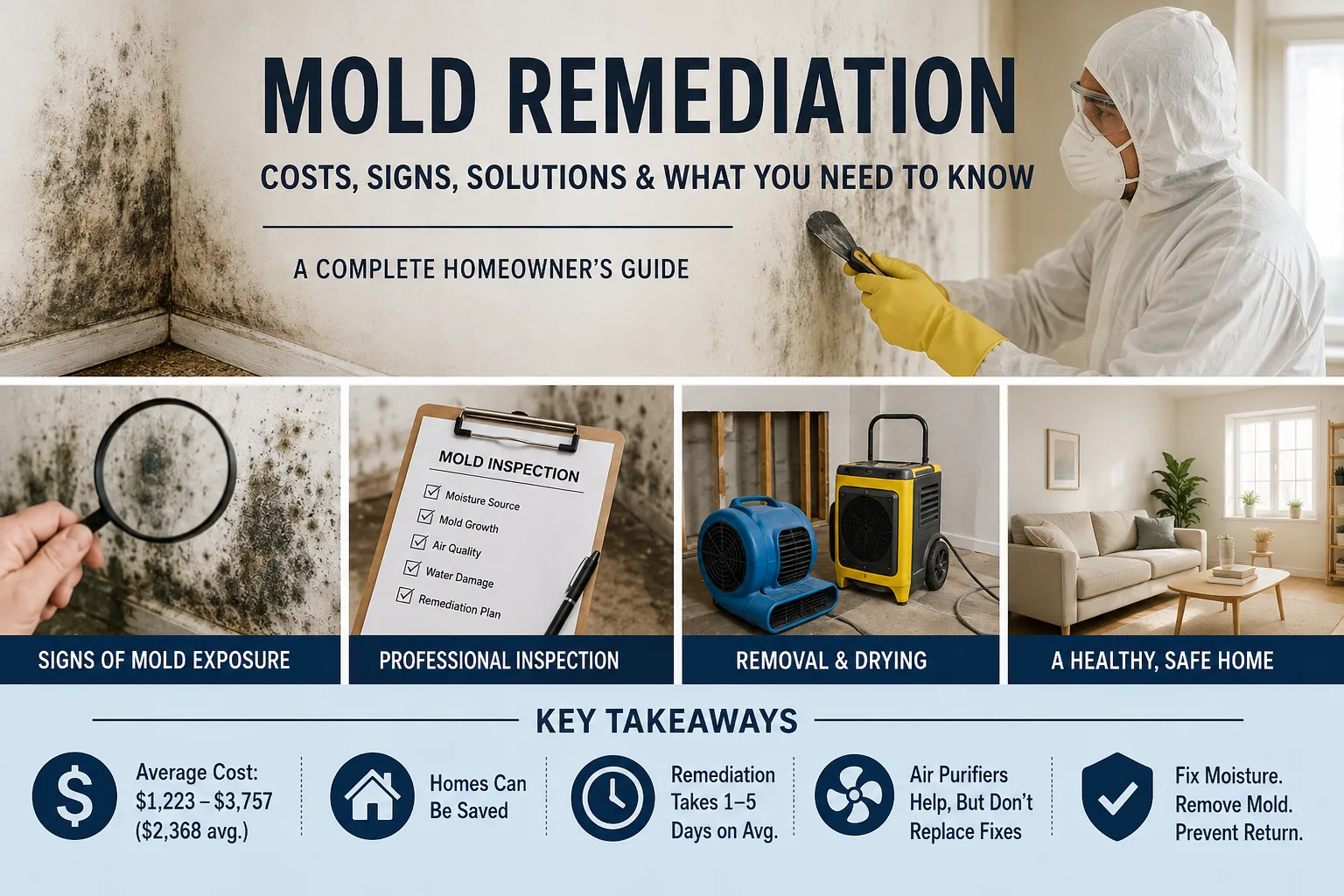
The average cost of professional mold remediation in the U.S. is about $2,368, with many homeowners paying between $1,223 and $3,757. Larger projects, hidden mold, HVAC contamination, damaged walls, or widespread moisture problems can push the total much higher.
There is no single price that applies to every mold problem. A small patch in an accessible bathroom is very different from mold growing throughout wall cavities, a crawl space, attic, basement, or HVAC system.
Current 2026 cost data indicates that professional remediation commonly runs around $10 to $25 per square foot. Location also matters. Basement projects may fall around $500 to $3,000, attic remediation can range from about $1,000 to $4,000, while extensive wall or HVAC contamination may cost considerably more; see the mold remediation cost guide.
The final bill usually depends on:
Size of the affected area
Location of the mold
Accessibility
Amount of containment required
Moisture or water damage
Materials that need to be removed
Drying requirements
Inspection or testing needs
Reconstruction after remediation
Mold remediation also involves more than cleaning a dark stain from a wall. A successful project should address the moisture source that allowed the mold to grow. The EPA emphasizes that mold will likely return if the mold is cleaned but the underlying water problem remains.
This is why homeowners comparing remediation estimates should look at the complete scope of work rather than simply choosing the lowest number.
Can a House Full of Mold Be Saved?
Yes. A house with extensive mold can often be saved, although the amount of restoration required depends on how long moisture and mold have been damaging the building, as explained in the mold restoration process.
Finding mold throughout a house does not automatically mean the property is beyond repair.
The remediation process may involve removing contaminated drywall, insulation, carpet, flooring, ceiling materials, or other porous materials while cleaning and drying structural components that can still be restored.
The EPA explains that mold damages the materials it grows on and that the longer mold remains, the greater the potential damage. This makes early intervention important.
A heavily affected property may require several stages:
Identify the source of moisture.
Determine how far contamination has spread.
Isolate affected areas.
Remove materials that cannot be restored.
Clean appropriate surfaces.
Dry the structure.
Correct leaks or moisture problems.
Replace damaged building materials.
The condition of structural components is especially important. Long-term water exposure may damage wood framing, subflooring, drywall, or other building materials independently of the mold itself.
In severe cases, remediation can become a major restoration project. However, widespread mold does not by itself mean the entire house must be demolished.
The key question is not simply how much mold is visible, but how much moisture-related damage has occurred behind the visible surfaces.
What Are Signs of Mold Exposure?
Common signs associated with mold exposure include a stuffy nose, sore throat, coughing, wheezing, irritated eyes, and skin irritation.
According to the CDC, exposure to damp and moldy environments may cause symptoms in some people while causing no noticeable symptoms in others.
Possible symptoms include:
Nasal congestion
Runny or stuffy nose
Sore throat
Coughing
Wheezing
Burning or irritated eyes
Red or itchy eyes
Skin rash or irritation
Worsening asthma symptoms
People with asthma or mold allergies may experience stronger reactions. People with weakened immune systems or certain chronic lung conditions can also face additional risks from fungal exposure.
However, these symptoms are not unique to mold exposure.
A cough, irritated eyes, congestion, or breathing symptoms can have many possible causes. Symptoms alone cannot confirm that mold in a particular building is responsible.
If symptoms persist, worsen, or include significant breathing difficulty, medical evaluation is more appropriate than trying to diagnose the cause based on the appearance of mold in a home.
From the property side, visible mold, recurring moisture, water stains, previous flooding, and persistent musty smells are signs that the building itself should be investigated.
How Long Does It Take to Remediate Mold in a House?
Many contained mold remediation projects can take roughly one to five days, but larger or more complicated projects can take longer.
The timeline changes depending on how much mold is present, where it is located, how wet the structure is, and whether building materials need to be removed.
Restoration providers note that smaller remediation projects may take only a few days, while larger problems involving hidden contamination, extensive drying, demolition, or reconstruction can extend well beyond the initial remediation period.
A typical project may include several separate stages:
Inspection and assessment: The affected areas and moisture source are identified.
Containment: The work area may be isolated to reduce movement of contaminated dust and spores.
Material removal and cleaning: Damaged porous materials may be removed while salvageable surfaces are cleaned.
Drying: Damp structural materials need time to reach appropriate moisture levels.
Verification: The remediated area is checked for remaining moisture, visible contamination, or other concerns.
Reconstruction: Drywall, flooring, insulation, or other removed materials may then need to be replaced.
That last stage is important when discussing timelines. Mold remediation and rebuilding are not necessarily the same job.
A contractor may finish removing mold within several days, while repairing walls, flooring, cabinets, or other damaged parts of the house takes additional time.
What to Do if You Can’t Afford Mold Remediation?
If professional remediation is currently outside your budget, focus first on stopping the moisture problem and determining how large the mold-affected area actually is.
Do not simply paint over the mold or ignore an active leak.
For relatively small areas, the EPA says homeowners can often handle mold cleanup themselves when the affected area is less than about 10 square feet, assuming there are no special circumstances such as extensive water damage or contaminated water.
For a larger problem, consider several practical steps before deciding you have no options.
Fix the water source first.
A leaking pipe, roof leak, plumbing issue, drainage problem, or persistent condensation can continue feeding mold growth. Stopping additional moisture may prevent the affected area from becoming larger.
Get more than one remediation estimate.
Ask contractors to break down what they are proposing. One estimate may include demolition, reconstruction, testing, and other work that another company separates into different stages.
Ask whether the project can be completed in phases.
Depending on the situation, urgent moisture control and contaminated-material removal may be separated from cosmetic reconstruction.
Check your homeowners insurance policy.
Mold coverage varies considerably. Some policies may cover mold remediation when the mold results from a covered event, such as certain sudden plumbing failures or covered water losses. Mold caused by long-term neglect or maintenance problems is often treated differently.
Document the damage.
Photographs, dates, repair records, leak reports, and information about the original water event can be useful when speaking with an insurer.
If the mold problem resulted from a major declared disaster, homeowners may also want to check whether disaster-related assistance is available in their area.
Most importantly, avoid turning a manageable mold problem into a larger repair by leaving an active water source unresolved.
Can Black Mold Be Fully Remediated?
Yes, active growth commonly described as “black mold” can be remediated, but a home cannot realistically be made completely free of every mold spore.
There is also an important misunderstanding around the term black mold.
The EPA states that “black mold” is not a specific species or category of mold. Mold can appear in many colors, and color alone does not determine how a mold problem should be handled.
Stachybotrys chartarum is one mold sometimes associated with the phrase, but homeowners generally do not need to identify the species before addressing an obvious moisture and mold problem.
Remediation should focus on:
Removing active mold growth
Discarding materials that cannot be adequately restored
Cleaning salvageable materials
Containing contamination when necessary
Drying the affected area
Correcting the moisture source
The EPA also notes that it is impossible to eliminate all mold and mold spores from indoor environments. The practical objective is to prevent indoor mold growth by controlling moisture.
So when someone says mold has been “fully remediated,” the realistic meaning is that the active mold problem and moisture conditions have been appropriately addressed, not that every microscopic mold spore has disappeared from the building.
Do Air Purifiers Help With Mold?
Yes, an appropriate air purifier can capture some airborne mold particles, but it cannot solve an active mold problem inside a house.
HEPA filtration is particularly useful for airborne particles. According to the EPA, a HEPA filter can theoretically capture at least 99.97% of particles measuring 0.3 microns, including mold particles that pass through the filter.
That sounds impressive, but there is an important distinction between filtering airborne particles and remediating mold.
The EPA specifically states that portable air cleaners and HVAC filters do not address the underlying cause of mold growth. They may remove some particles generated by mold and may sometimes reduce odors, but they will not correct the water or moisture problem allowing mold to grow.
For example, imagine mold is growing behind drywall because a plumbing connection has been leaking for three months.
An air purifier may capture some particles released into the room.
It cannot:
Repair the leaking pipe
Dry the wall cavity
Remove contaminated drywall
Clean affected framing
Prevent mold from continuing to grow
Air filtration should therefore be treated as a supporting indoor-air-quality measure rather than a substitute for remediation.
The EPA also recommends avoiding air-cleaning devices that intentionally produce ozone because ozone can irritate the lungs.
Is Professional Mold Removal Worth It?
Professional mold remediation can be worth the expense when contamination is widespread, hidden, recurring, caused by extensive water damage, or located in areas that are difficult to clean safely.
For a tiny patch of accessible mold, hiring a full remediation crew may not always be necessary.
The EPA says that areas smaller than about 10 square feet can often be handled by homeowners following appropriate cleanup guidance. Larger problems deserve more careful evaluation.
Professional remediation becomes more valuable when mold is:
Spread across multiple areas
Growing behind drywall
Inside wall or ceiling cavities
Associated with substantial flooding
Present in an HVAC system
Growing throughout a crawl space
Returning after previous cleaning
Connected with an unidentified moisture source
Affecting large amounts of porous building material
The value of professional remediation is not simply that someone cleans the visible mold.
A thorough scope should address containment, contaminated materials, hidden moisture, drying, cleanup, and prevention of recurrence.
If you hire a contractor, the EPA recommends choosing someone with mold-cleanup experience, checking references, and asking whether they follow recognized government or professional remediation guidance.
A useful question to ask a remediation company is:
“What moisture problem caused this mold, and what needs to change so it does not return?”
If an estimate only addresses the visible discoloration and says nothing about moisture, that deserves further questioning.
How Much Does It Cost to Get Rid of Mold in Your House?
For many professional mold-remediation projects, homeowners currently spend around $1,223 to $3,757, with an average near $2,368. Extensive whole-house remediation can cost approximately $10,000 to $30,000, depending on the severity of contamination and required restoration.
Those figures are broad planning ranges rather than guaranteed project prices.
For example, current cost estimates suggest approximate ranges such as:
Basement: $500 to $3,000
Crawl space: $500 to $2,000
Attic: $1,000 to $4,000
HVAC system: $3,000 to $10,000
Extensive wall contamination: potentially $1,000 to $20,000
Whole-house remediation: roughly $10,000 to $30,000
The reason for such large differences is that mold itself is only one part of the project.
Consider two houses that both have visible mold.
In the first house, the growth is limited to one accessible wall after a small plumbing leak.
In the second, a long-term roof leak has allowed moisture to reach insulation, drywall, ceiling materials, framing, and several adjoining rooms.
Calling both projects simply “mold removal” hides the enormous difference in labor and repair requirements.
Homeowners should therefore ask for a written scope showing what is included in the estimate, particularly whether the quoted price includes:
Containment
Removal of damaged materials
Cleaning
HEPA filtration or vacuuming
Structural drying
Disposal
Moisture-source repairs
Post-remediation evaluation
Drywall or flooring replacement
Painting and finishing
Professional inspection can also be a separate expense. Current 2026 data places many mold inspections between roughly $303 and $1,045, with an average near $671, depending on property size, accessibility, sampling, and testing requirements.
Ultimately, the cost of getting rid of mold depends on what caused it and how far the resulting damage has spread.
Cleaning visible mold without correcting moisture may make the area look better temporarily, but it does not provide a lasting solution. The EPA’s guidance is straightforward: control the moisture, clean up the mold, and correct the water problem so the growth does not return.